

ICF is a powerful heat insulation form which replaces wood casing and consists of two sheets of expanded polystyrene EPS 250 of 5,20cm thickness.
Thermal insulation forms are assembled at the construction site, placed in a cascaded arrangement, and are connected among them with PVC spacers which are placed on top of the sheets, forming a rectangular space of 20 cm.
Subsequently this space is reinforced with B500Cc steel depending on structural demands and finally is cast in concrete C25/30.
WHY ICF IS THE FUTURE OF CONVENTIONAL CONSTRUCTION
We reduce building time
The form itself functions as an excellent thermal insulation.
The concrete is not left uncovered
It replaces the brick building
Countless possibilities for design and floor construction
WHY ANDROULAKIS ICF
We use expanded polystyrene EPS 250
We have bigger thickness (6.20cm), thus providing the best heat insulation coefficient of its kind.
We have greater length (1,20m)
ENERGY CLASSIFICATION
Androulakis ICF refers to houses with energy class Α.
The company has incorporated in the building and completion of the project inspection stages (structural design, simulator, air permeability control) which verify the classification Α+ and ensure the high energy independence of the residence.
Energy classification Α has different graduations.
A green construction residence with the same energy class (class Α+) as another may have significant difference regarding the level or required energy demands.
The classification of ICF residences is determined by the computing program of the regulation (ΚΕΝΑΚ)
As a point of reference and comparison we take an ideal building with energy class Β with specific insulation and technical features.
Then we compare the residence under examination with that ideal building and depending on comparisons the energy class is produced but also its percentual gradation.
Class Α+ 67% lower consumption than Β
Class Α 50% – 67% lower consumption than Β
Class Β+ 25% – 50% lower consumption than Β
Class Β 0 – 25% lower consumption than Β
ICF residences of our company by taking into account individual factors like design, position and the area microclimate are classified in energy class Α and fulfill the conditions set by the Passive House Institute.
*The energy requirements of the residences are calculated based on total primary consumption in heating, cooling and hot water use.
* The exact classification and calibration of the residence is produced by carrying out checking stages.
Hover the mouse over each item to see a detailed description.
U = 0,19 W/m2K
Innovative heat insulation form of reinforced concrete 350 mil. And heat penetration coefficient U=0,19 W/m2k
Steel of Greek manufacture S500.
Concrete Reinforcement Steel Β500c is the metal used in a reinforced concrete building. It is the basis safety and resistance material of a construction.
The main purpose of reinforcement steel is the resistance and stability of the construction, especially in the case of strong seismic tremors.
Reinforcement steel (bars, mesh) reinforces the load-bearing frame of the building and does not allow concrete to break or crack at critical points such as columns, beams, slabs etc.
During a seismic activity, the steel absorbs the seismic energy and prevents damage to the building.
Because of high earthquake incidence in our country the strict compliance with the engineer’s design and the use of high-resistance and high-ductility steel is required according to the specifications ELOT 1421.
Reinforcement steel Β500c used by our company are of Greek manufacture by the SIDENOR company, of excellent quality, with modern specifications, distinguished for excellent resistance, ductility, pliability and weldability properties, according to the demanding antiseismic regulations and the new ELOT standard 1421.
Hover the mouse over each item to see a detailed description.
The permanent shuttering system Betoboard is the new structural solution in the building of floors, which contributes to the improvement of the work but also the quality of the building work.
The panel has excellent welding properties and adhesion to concrete. After the completion of the layering and rebaring work all concreting and vibration work is done normally on the surface of the Betoboard.
After stripping at the usual time, the roof surface is smooth. The only thing required before it is painted is the work at the joints. Finally, Betoboard provides the possibility to incorporate the electrical installation of the roof.

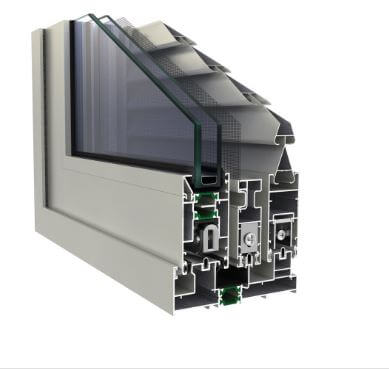
Aluminum frames with double glazing 4 seasons energy with low emission film (Low-e) and heat transfer coefficient Ug 1.0 W / m2k
Aluminum alloy: AIMgSi-0.5 F22
Hardness: 12 Webster
Minimum paint thickness: 75μm
Profile thickness: 1.4mm
Dimensional tolerances according to: EN 12020-02
Supervisor guide width: 120mm (two sheets)
Recessed guide width: 134mm (glass-screen-shutter)
Glass sheet thickness: 47mm
Glazing thickness of glass sheet: 20-34mm
Width of polyamides: 22mm
Frame Heat Permeability Coefficient: Uf = 4.3W / (m2K)